untitled
The RuleSpeak® Business Rule Notation

by Ronald G. Ross
In September 2005, the Object Management Group (OMG) approved
the "Semantics of Business Vocabulary and Business Rules" (SBVR)[1] to become a final adopted
specification of the OMG. SBVR, which is the first OMG standard for fact
models and business rules, is in finalization as of this writing.
SBVR is a highly-structured set of fundamental concepts, not a syntax for rule representation.
In part, this approach is necessary for multi-lingual support; in part, it is to
ensure support for a variety of representational schemes. One such scheme is
RuleSpeak®, which played a central role in the shaping and proofing
of the standard itself. The material that follows is extracted from the RuleSpeak
Annex of SBVR. |
RuleSpeak® is an existing,
well-documented[2] business rule
notation developed by Business Rule Solutions, LLC (BRS) that has been used with
business people in actual practice in large-scale projects since the second half
of the 1990s. A companion column in this issue of the Journal introduces
two styles of business rule statement -- prefixed rule keyword style and embedded
(mixfix) rule keyword style. That article details a business rule notation
within SBVR Structured English that features prefixing rule keywords onto appropriate
propositions.[3]
RuleSpeak can also use the constructs of SBVR Structured English, but embeds equivalent
keywords within the propositions themselves (mixfix).
As that article explains, more than one notation for expressing
business rules is possible using SBVR Structured English. (This is probably
also true for other notations compliant with SBVR.) Regardless of how expressed,
equivalent semantics can be captured[4]
and formally represented as logical formulations.
Expressions in RuleSpeak
RuleSpeak builds on the same expression forms described in
the SBVR Structured English Annex of SBVR (Annex C), with the minor difference that
distinct keywords are used for the Modal Operations related to business rules.
The following section presents the RuleSpeak alternative rule keywords for Rules
and Affirmations and Admonitions.[5]
Modal Operations in RuleSpeak
|
Modality claim
type
|
Statement form
|
SBVR Structured
English keywords
|
RuleSpeak keywords
|
| obligation claim |
'obligative statement' form |
it is obligatory that p |
r must
s |
| obligation claim embedding a logical negation |
'prohibitive statement' form |
it is prohibited that p |
r must not
s |
| 'restricted permission statement' form |
it is permitted that p only if q |
r may
s only t |
| permissibility claim |
'unrestricted permission statement' form |
it is permitted that p |
r may
s |
r need not
s |
| necessity claim |
'necessity statement' form |
it is necessary that p |
r always
s |
| necessity claim embedding a logical negation |
'impossibility statement' form |
it is impossible that p |
r never
s |
| 'restricted possibility statement' form |
it is possible that p only if q |
r can
s only t |
| possibility claim |
'unrestricted possibility statement' form |
it is possible that p |
r sometimes
s |
r can
s |
Notes:
p and q, and r, s,
and t, are all parts of the same proposition, say u.
- In a permissibility claim or a possibility claim, the '
only'
is always followed immediately by one of the following:
- an '
if' (yielding 'only
if').
- a preposition.
An example of a business rule statement using the 'only
[preposition]' form is the following:
A spot discount for a rental may be given only
by a branch manager. |
Example in RuleSpeak
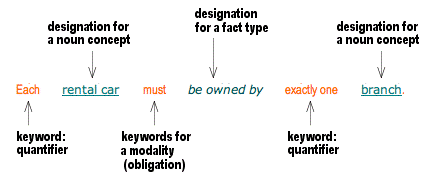
Each rental car must
be owned by exactly one branch. |
The example above includes three keywords or phrases, two terms (designations
for noun concepts), and one fact type symbol (designation for a fact type), as illustrated
below.

As noted above, every Operative Business Rule or Affirmation or Admonition can
be stated by using one of the following embedded keywords.
must |
or should |
rule keyword |
must not |
or should not |
rule keyword |
only |
often as in only if |
rule keyword |
may |
or need not |
affirmation / admonition keyword |
Every Structural Rule or Affirmation or Admonition can be stated by using one
of the following embedded keywords.
always |
|
rule keyword |
never |
|
rule keyword |
can ... only |
often as in can ... only if |
rule keyword |
sometimes |
or not always
or can |
affirmation / admonition keyword |
Special-purpose keywords for indicating specific kinds of Structural Rules include
the following. In these forms, 'always'
is assumed implicit.
is to be considered |
|
for derivation or inference |
is to be computed as |
|
for computation |
is to be fixed at [number] |
or is to be [number] |
for establishing constants |
Among the most basic usage rules and guidelines of RuleSpeak are the following.
(Note that these usage rules and affirmations/admonitions are given using proper
RuleSpeak notation.)
| 1. |
'Should' may
be used in place of 'must' in expressing
a business rule only if one of the following
is true:
- The business rule does not have an enforcement level.
- The business rule has an enforcement level, and that enforcement level is consistent
with the English sense of '
should'.
Comment: To say this differently:
'Should' must not be used in place of 'must'
in expressing a business rule if all of the following are true:
- The business rule has an enforcement level.
- The enforcement level of the business rule is inconsistent with the English sense
of '
should'.
|
| 2. |
'May' must
be used in the sense of 'permitted to' in RuleSpeak.
'May' must
not be used in the sense of 'might'.[6] |
| 3. |
An affirmation or admonition must not include
a rule keyword. |
| 4. |
A statement expressing a rule or affirmation or admonition should
not begin with a condition.
Comment: 'Condition' as used here means a qualification set off by 'if', 'while',
'when', etc. (e.g., 'If a rental is open....'). |
| 5. |
A double negative should be avoided in
expressing a rule in RuleSpeak.
Comment: Double negatives, especially using two 'not's, are generally
undesirable in good English usage, and often prove particularly troublesome in rule
statements.
Example:
| Rule: |
A withdrawal
from an account
must not be
made if the account
is not
active. |
| Revised rule: |
A withdrawal
from an account
may be
made only if the account is
active. |
Comment: The revised rule is expressed in the form of a 'restricted
permissive statement'. |
References
[1] Semantics of Business Vocabulary and Business Rules
(SBVR). First Interim Specification, March 2006. Available as dtc/06-03-02
at http://www.omg.org 
[2] Ronald G. Ross. Principles of the Business
Rule Approach. Boston, MA: Addison-Wesley, 2003, Chapters 8-12.
Versions of RuleSpeak have been available on the Business Rule Solutions, LLC website
(www.BRSolutions.com)
since the late 1990s. Public seminars have taught the syntax to thousands of
professionals starting in 1996 (www.AttainingEdge.com).
The original research commenced in 1985, and was published in The Business Rule
Book, 1994 (www.BRSolutions.com).

[3] SBVR Excerpt, "Notations for Business Rule Expression,"
Business Rules Journal, Vol. 7, No. 4 (Apr.. 2006), URL: http://www.BRCommunity.com/a2006/b286.html

[4] For a business-oriented, SBVR-compliant approach,
see: Ronald G. Ross. Business Rule Concepts: Getting to the
Point of Knowledge. 2nd ed.: Business Rule Solutions, LLC, 2005,
Chapters 4-5 (www.BRSolutions.com).

[5] It is important to note that use of these keywords
must be in a context that is clearly indicated to be for Rules and Affirmations/Admonitions
only. 
[6] Principles of the Business Rule Approach, p.
130. 
|
about
. . .
RONALD
G. ROSS |
Ronald G. Ross is Principal and Co-Founder of Business Rule Solutions, LLC,
where he actively develops and applies the IPSpeak™ methodology including RuleSpeak®,
DecisionSpeak™ and TableSpeak™.
Ron is recognized internationally as the "father of business rules." He is the author of ten professional
books including the groundbreaking first book on business rules The Business Rule Book in 1994.
His newest are:
Ron serves as Executive Editor of BRCommunity.com and its flagship publication,
Business Rules Journal. He is a sought-after speaker at conferences world-wide. More than 50,000 people have
heard him speak; many more have attended his seminars and read his books.
Ron has served as Chair of the annual International Business Rules &
Decisions Forum conference since 1997., now part of the Building Business Capability (BBC) conference. He was a charter member of the Business Rules Group (BRG) in the 1980s,
and an editor of its Business Motivation Model (BMM) standard and the Business Rules Manifesto. He is active in OMG standards development, with core involvement in SBVR.
Ron holds a BA from Rice University and an MS in information science from Illinois Institute of Technology.
For more information about Mr. Ross, visit www.RonRoss.info, which hosts his blog. Tweets: @Ronald_G_Ross
|
|
|
May 2013
Re-Cycling Shut-Down
Let's Face It — Some Rules Are Just Silly!
By Ronald G. Ross
April 2013
Tabulation of Lists in RuleSpeak® — Using "The Following" Clause
By Ronald G. Ross
March 2013
Requirements are Rules: True or False?
By Ronald G. Ross
February 2013
Breaking the Rules: Breach Questions
By Ronald G. Ross
January 2013
Business Rules, Business Processes, and Business Agility: Basic Principles — Celebrating the 10th Anniversary of the Business Rules Manifesto (Part 3)
By Ronald G. Ross
December 2012
Business Rules, Business Processes, and Business Agility: Basic Principles — Celebrating the 10th Anniversary of the Business Rules Manifesto (Part 2)
By Ronald G. Ross
November 2012
Strategy for Business Solutions: Part 3: Adjusting and Fine-Tuning a Strategy
By Ronald G. Ross with Gladys S.W. Lam
October 2012
Strategy for Business Solutions: Part 2 — Business Mission and Business Goals
By Ronald G. Ross with Gladys S.W. Lam
October 2012
Big-P Process is Dead; Long Live Configuration Agility!
By Ronald G. Ross
September 2012
Strategy for Business Solutions: Part 1 — The Policy Charter
By Ronald G. Ross with Gladys S.W. Lam
August 2012
Business Rules, Requirements, and Business Analysis: Basic Principles — Celebrating the 10th Anniversary of the Business Rules Manifesto
By Ronald G. Ross
July 2012
Strategy-Based Metrics for Measuring Business Performance
By Ronald G. Ross with Gladys S.W. Lam
June 2012
How Business Processes, Strategy, and Business Policies Relate
By: Ronald G. Ross
May 2012
Business Processes: Better with Business Rules
By: Ronald G. Ross
April 2012
Business Policies, Business Rules, and Rulebook Management: Let Us Be Well-Governed
By: Ronald G. Ross
March 2012
What's Really Needed to Align Business and IT Part 2: Strategy for a Business Solution
By: Ronald G. Ross
February 2012
What's Really Needed to Align Business and IT Part 1: Creating True Business Solutions
By: Ronald G. Ross
January 2012
Concept Model vs. Fact Model vs. Conceptual Data Model; Just a Matter of Semantics?
By: Ronald G. Ross
December 2011
Business Rules: Basic Principles
By: Ronald G. Ross with Gladys S.W. Lam
November 2011
Know-How Models: How Business Rules, Decisions, and Events Relate in True-to-Life Business Models
October 2011
Business Analysis with Business Rules
By: Ronald G. Ross with Gladys S.W. Lam
September 2011
How Business Processes and Business Rules Relate
August 2011
Decision Analysis (Part 3): Defining Scope
July 2011
Decision Analysis (Part 2): The Basic Elements of Operational Business Decisions
June 2011
Decision Analysis (Part 1): What Kind of Decisions?
May 2011
How Long Will Your Fact Model Last? — The Power of Structured Business Vocabularies
April 2011
More on the If-Then Format for Expressing Business Rules: Questions and Answers
March 2011
Operational Business Decisions
Whose Decisions Are They Anyway?
February 2011
The Anatomy of Decisions
The Business-Rule View
January 2011
Why Rulebook Management? Because Software Requirements and Business Rules Simply Aren't the Same!
December 2010
Introducing Question Charts (Q-Charts™) for Analyzing Operational Business Decisions: A New Technique for Getting at Business Rules
November 2010
Agility Based on Business Rules
It's Just Common Sense
October 2010
Five Tests for What Is a Business Rule?
September 2010
Can a Business Rule Be Enforced Differently in Different Contexts?
August 2010
How Far Can You Take Decisioning?
July 2010
Business Rules vs. System Design Choices
June 2010
Four Useful Constructs for Developing a Structured Business Vocabulary: Special-Purpose Elements of Structure for Fact Models
May 2010
Eight Things You Need to Know About Fact Types Bringing Verbs into Structured Business Vocabulary
April 2010
Business Vocabulary: The Most Basic Requirement of All
March 2010
What Is a Business Rule?
February 2010
CRUD in Business Rules: Accident-Prone Decision Logic
January 2010
The Point of Knowledge
December 2009
When is an Exception Really an Exception? The Business Rule Principles of Accommodation and Wholeness
November 2009
Verb-ish Models for Verbalization: Give Us Back Our Verbs!
October 2009
From Rulebook Management to Business Governance: Where Business Rules Fit
September 2009
What You Need to Know About Rulebook Management
August 2009
When Is a Door Not a Door? ~ Basic Ideas of the Business Rules Paradigm
July 2009
General Rulebook Systems (GRBS): What's the General Idea?
June 2009
Becoming Strategy-Driven: The Policy Charter
May 2009
Product Quality and a Longer-Term View: A 'Simple' Matter of Business Policies
April 2009
RuleSpeak® Sentence Forms: Specifying Natural-Language Business Rules in English
March 2009
The Rulebook: To Play Ball You Need Rules
February 2009
Extreme Business Agility (Part 6): A Manifesto-in-Progress on the Semantic Re-Engineering of Products
January 2009
Extreme Business Agility (Part 5): The Optimal Edge of Business Performance
December 2008
Extreme Business Agility (Part 4): Change Deployment Hell
November 2008
Extreme Business Agility ~ Part 3: Examples of Non-Agile vs. Agile Business Capabilities
October 2008
Extreme Business Agility ~ Part 2: A Semantic Approach to Re-Engineering Your Company's Products
September 2008
Extreme Business Agility — Part 1: A Value Chain for Re-Engineering Your Company’s Products
August 2008
My Son, Business Rule Analyst — Governance and Compliance Through Young Eyes
July 2008
Rules vs. Processes (Again) — Part 2: Now for Events
June 2008
Rules vs. Processes (Again) — Part 1: There’s Simply No Need for Confusion
May 2008
Legacy Modernization, Semantics, and the Knowledge Economy ~ Have You Connected the Dots Yet?!
April 2008
The Emergence of SBVR and the True Meaning of ‘Semantics’: Why You Should Care (a Lot!) ~ Part 2
March 2008
The Emergence of SBVR and the True Meaning of ‘Semantics’: Why You Should Care (a Lot!) ~ Part 1
February 2008
The Phoenix Strategy ~ A Lower-Risk Approach to Rejuvenating Systems and Legacy Modernization
January 2008
'Rules of Record' Why 'System of Record' Isn't Enough
December 2007
The Decision Center: A Center of Excellence for Coordinating Business Rules and Other Process 'Smarts'
November 2007
The Latency of Decisions ~ New Ideas on the ROI of Business Rules
October 2007
Legacy Systems -- Poorly Engineered or Over-Engineered? New Insights about Business Rules and Enterprise Decisioning
September 2007
The Value of Decisions ~ New Ideas on the ROI of Business Rules
August 2007
A Case of Dueling Manifestos? Business Rules and Enterprise Decision Management
July 2007
What's Wrong with If-Then Syntax For Expressing Business Rules ~ One Size Doesn't Fit All
June 2007
Are IT Terms Fundamental to Every Business? Not!
May 2007
Are all Rules Business Rules? Not!
April 2007
Are Software Requirements Rules? Not!
March 2007
Are Integrity Constraints Business Rules? Not!
February 2007
From Rule Management to Business Governance, Part 4: Governance Engineers and the Chief Governance Officer (CGO)
January 2007
From Rule Management to Business Governance, Part 3: Re-Engineering the Governance Process
December 2006
From Rule Management to Business Governance, Part 2: Governance and How it Relates to Business Rules
November 2006
From Rule Management to Business Governance, Part 1: Governance and How it Relates to Business Rules
October 2006
Rules and Processes: Examples Showing How They Relate
September 2006
The Meaning of Things: Definitions, Intensions, Rules, and Extensions
August 2006
Re-Vitalize, Don't Just Re-platform! ~ Three Tests for Whether Your Company 'Gets It' with Respect to Re-Platforming Business IP
July 2006
The Dirty Secrets About Your Company's Business IP That Nobody Wants to Talk About
June 2006
A Personal Insurance Saga ~ The Economics of Business Rules
May 2006
Concepts, Definitions, and Rules: RuleSpeak® Practices
April 2006
The RuleSpeak® Business Rule Notation
March 2006
How Rules and Processes Relate ~ Part 6. Point-of-Knowledge Architecture (POKA)
February 2006
How Rules and Processes Relate ~ Part 5. Scripts -- Rule-Friendly Process Models
January 2006
How Rules and Processes Relate ~ Part 4. Business Processes vs. System Processes
December 2005
How Rules and Processes Relate ~ Part 3. Three Best Practices for Designing Business Processes with Rules
November 2005
How Rules and Processes Relate ~ Part 2. Business Processes
October 2005
How Rules and Processes Relate ~ Part 1. The Challenges
September 2005
Rule Quality ~ The Route to Trustworthy Business Logic
August 2005
Decision Tables, Part 2 ~ The Route to Completeness
July 2005
Decision Tables, Part 1 ~ The Route to Consolidated Business Logic
June 2005
Rule Reduction ~ The Route to Atomic Business Rules
May 2005
Essence Definitions and Business Rules ~ Developing Stable Anchor Points for Operational Knowledge
April 2005
Can You Violate Structural Rules? (part 3) ~ The Difference Between Breaking Rules and 'Breaking' Knowledge
March 2005
Can You Violate Structural Rules? (Part 2) ~ The Difference Between How to Compute and How to Behave
February 2005
Can You Violate Structural Rules? (Part 1) ~ The Difference Between Violations and Bad Decisions
Janauary 2005
Business Rules and Knowledge Workers ~ Getting to the 'Point of Knowledge'
December 2004
Can a Definition be Violated? ~ Definitions and Business Rules
November 2004
Rustling Up Good Definitions ~ There's a Lot Less and a Lot More to It
October
2004
Clarifying
Clarifications ~ Universal 'And' to the Rescue
September
2004
Relearning
the Basics of Communicating ~ Business Semantics and Business Rules
August
2004
The
Light World vs. the Dark World ~ Business Rules for Authorization
July
2004
Best-Fit
Decision Points ~ How They Fit into the Business Rule Approach
June
2004
What
Rule Independence Means to System Models ~ Less
and More than You Think!
May
2004
The
Semantics Lexicon ~ Terms For The Business Rules / Smart Process
April
2004
Don't
Reinvent Rule Engines!
March
2004
Rules
And Compliance Tactics
February
2004
Tracing
the Path of Rule Reduction
December
2003
Do
Rules Decompose To Processes Or Vice Versa?
November
2003
Should
You Encapsulate Knowledge in Modeling Real-World Things?
October
2003
Business
Rules, Encapsulation, and Models of the Real World
September
2003
Business
vs. Environment in Business Models
August
2003
Requirement
Statement vs. Rule Statement
July
2003
Rules
as Constraints: On or By the System
Design?
June
2003
Rules
Reveal Events -- Not Actions
May
2003
Actions
Are Not Rules (and Vice Versa)
April
2003
The
Definitions of 'Business Rule' and 'Rule'
March
2003
Business
Problems Addressed by the Business Rule Approach
January
2003
About
the Business Rules Manifesto ~ The Business Rule Message in a Nutshell
November
2002
Business
Rules for the Company's Provisioning Processes ~ There’s a Lot More to
Reference Data than Just Data!
September
2002
The
Terminator -- I'll be Back (with Just the Right Term)
July
2002
What
Does it Mean to be Business-Driven? (Part 2)
May
2002
What
Does it Mean to be Business-Driven? (Part 1)
March
2002
A
Telltale E-mail Trail: The Case for
In-Line Business Rule Analysis
January
2002
Managing
M x N Vs. M + N, Market-Driven Economies, and Other eCommerce Issues (part 2)
November
2001
Managing
M x N Vs. M + N, Market-Driven Economies, and Other eCommerce Issues (part 1)
September
2001
The
BRS Rule Classification Scheme
July
2001
Minding
Your P's and Q's
May
2001
RuleSpeak"!
-- Templates And Guidelines For Business Rules
March
2001
Business
Rules In Business Processes ~ Title Rules For Process And Rules For
Product/Service
January
2001
What
Is Rule Management About?
November
2000
Let's
Make a Deal: A Killer App for Business Rules
September
2000
The
Re's Of Business Rules
July
2000
What
Are Fact Models And Why Do You Need Them? (Part 2)
May
2000
What
Are Fact Models And Why Do You Need Them? (Part 1)
March 2000
What
is a 'Business Rule'?
January
2000
Current
Thoughts On Expressing Business Rules
November
1999
The
Fin de Siegle Legacy Mindset
September
1999
Analysis
Paralysis Just May Save Your Life
July
1999
If
We Had Started Coding Already...
May
1999
Your
Core Business Processes Need a Rule Engine
March
1999
Who
or What is a True Business Analyst?
January
1999
Four
Things Wrong with the Way We Develop Information Systems
November/December 1998
Push-Type Data Hub vs. Pull-Type Data Warehouse
By Ronald G. Ross
September/October 1998
What Knowledge Management is About (And What it Has To Do With Business Rules)
By Ronald G. Ross
May/June 1998
The Next Great Leap Forward ~ About the Changes You See
By Ronald G. Ross
March/April 1998
Business Rules as Customer Interface
By Ronald G. Ross
January/February 1998
Components and Business Rules: Do They Connect?
By Ronald G. Ross
November/December 1997
The Policy Charter: A Small-Sized Picture of the Big Picture
By Ronald G. Ross
September/October 1997
Implementing
Application Packages: Is There A Better Way?
By
Ronald G. Ross
July/August 1997
'Why'
is Why Business Rule Methodology is Different
By
Ronald G. Ross
May/June 1997
Never-ending
On-the-Job Training
By
Ronald G. Ross
September/October 1996
Re-Usability
in the Business Rule Approach
By
Ronald G. Ross
March/April 1996
The
Newest Idea In Business Rules: Rules Normalize!
By
Ronald G. Ross
January/February 1996
An
Open Letter to DBMS Vendors: We Need Active Database Systems
By
Ronald G. Ross
May/June 1995
The
Greatest Irony Of The Information Age: Business Rules
By
Ronald G. Ross
November/December 1995
Business
Rules:
Knowledge For Knowledge Workers
By
Ronald G. Ross
March/April 1994
"Play
Ball!"
By
Ronald G. Ross
November/December 1988
The
History Of Steam-Powered Ships
By
Ronald G. Ross
January/February 1994
"Business
Rules, At What Cost?"
By
Ronald G. Ross
May/June 1994
Business
Rules: Birth of a Movement
By
Ronald G. Ross
July/August 1991
Why
I Like the Zachman Framework Architecture"
By
Ronald G. Ross
March/April 1997
Business
Process Re-Engineering
By
Ronald G. Ross
|