
Having a BPM Maturity Model is Important for Long Lasting BPM Success


Most businesses have a limited, explicit understanding of end-to-end business processes, and if any understanding exists, it is often tucked away within disparate groups across the organization. It's rare to find an organization that has linked its scattered process competencies together into a comprehensive strategy. This is changing as business process management (BPM) gains momentum. Gartner has created a six-phase BPM maturity model that involves understanding the six phases of BPM maturity and where your organization stands on addressing critical success factors defined in a BPM maturity framework.
The Six Phases of BPM Maturity -- Overview
The business process management maturity and adoption model provides guidance for how your organization can more easily navigate the challenges of becoming process managed.
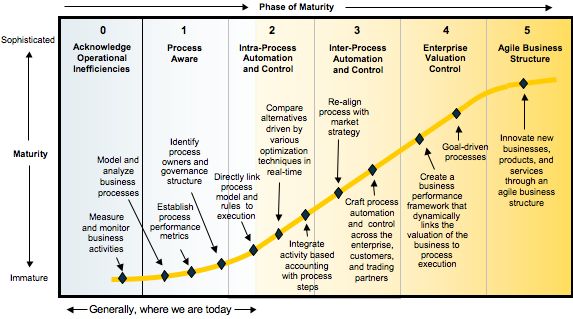
Figure 1. The six phases of BPM maturity.
Source: Gartner.
The journey toward a fully process-driven organization begins in Phase 0 with acknowledgment that some business improvement opportunities cannot be addressed by conventional approaches. The need to seek fundamental operational change results in Phase 1, becoming "process aware." As the organization becomes more process aware, it enters Phase 2 when it begins automating specific processes to gain better control.
Eventually, the boundaries of individual processes expand, and in Phase 3, the organization must integrate these processes with each other, as well as those of trading partners and customers. Competencies grow around managing the relationships between major business processes and, by Phase 4, the expertise exists to dynamically link strategic goals to process execution. This, ultimately, leads to the creation of an agile business structure (Phase 5) -- the highest level of maturity.
The curve embedded in the maturity model represents the amount of effort, and subsequent benefit, that will accrue in each phase. As you approach the more advanced phases, the steepness of the curve shows that more work is required, but more return value is expected. This is a hallmark of maturity: wisdom comes from investment, and wisdom begets increased benefit.
The majority of organizations are in the earlier phases of BPM maturity. Although many organizations will be deep into learning the disciplines of Phase 2 by the end of 2006, few will have mastered the process automation and control competencies. Therefore, the percentage of enterprises mastering any particular phase will be much smaller than the percentage experiencing or experimenting with the same phase. Further, mastery of the more advanced phases will remain elusive well beyond 2008. We set the bar high when we created this maturity model.
The BPM Maturity Model and Its Critical Success Factors
The BPM maturity model is based on the belief that superior process management leads to realizing a truly agile business structure. The competencies gained along the way to becoming agile create greater visibility into how the organization delivers value, innovates customer service, and gains operational productivity and effectiveness. Each phase of maturity builds on the previous phases, but also allows for initiatives that grow competencies for later phases to occur during earlier phases. The object then becomes managing the "weakest link" when balancing the critical success factors of organizational process management.
In addition to the six phases of maturity, the other important dimension is the organizational factors that must be balanced within and between phases. Figure 2 (adopting concepts developed at the Babson College Process Management Research Center) displays six critical success factors that an organization must evolve during each phase as it becomes process driven.
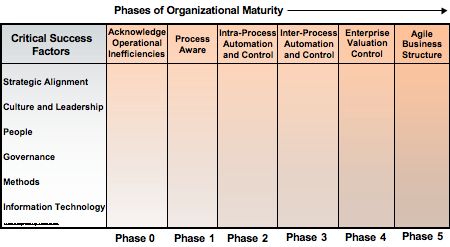
Figure 2. BPM Maturity Framework
Source: Gartner and Babson College Process Management Research Center (2006)
As the organization ascends through each phase of maturity, the achievement of its critical success factors must also evolve. Leading organizations take a balanced approach to managing the six critical success factors. Managed together, they represent the framework from which BPM competencies are built. The six success factors are:
- Strategic alignment: The continual tight linkage of organizational priorities
and enterprise processes, enabling the achievement of business goals.
- Culture and leadership: The collective values and beliefs that shape process-related
attitudes and behaviors.
- People: The individuals and groups who continually enhance and apply their process
related expertise and knowledge.
- Governance: Relevant and transparent accountability, decision making and
reward processes to guide actions.
- Methods: The approaches and techniques that support and enable consistent
process actions and outcomes.
- Information technology: The software, hardware and information management systems that enable and support process activities.
Gartner has more detailed information on each of the phases and the typical outcomes for each of the success factors on its business process improvement site. In early 2007, Gartner will be providing a self-evaluation tool.
The Bottom Line
Without a map, the journey to BPM maturity will be difficult and frustrating. What is provided here is a starting point for organizations to map out their journey ahead of time and determine the proper number of rest stops along the way to the ultimate destination, which may or not be the last phase. We believe your competition will drive you far into this maturity curve.
# # #
Standard citation for this article:

About our Contributor(s):









Online Interactive Training Series
In response to a great many requests, Business Rule Solutions now offers at-a-distance learning options. No travel, no backlogs, no hassles. Same great instructors, but with schedules, content and pricing designed to meet the special needs of busy professionals.