Search ::     [ Advanced ]
Username:   Password: Auto login next time?  


International Business Rules Forum

RuleXpress: The business tool for expressing and communication business rules.

AttainingEdge : World Class Training For Critical Business Innovations


     ROSS ARCHIVES ...
untitled

Premise and Conclusion

Rules vs. Processes (Again) — Part 2
Now for Events[1]

by Ronald G. Ross

Processes connect to rules via events.  Processes produce events, which can fire one or more rules (i.e., cause the rule(s) to be evaluated).  The rules might determine whether the event is undertaken correctly or will produce a desired outcome.  The rules also might make some decision.  The rules are externalized from the processes and established as a separate resource.  This permits direct management of the rules, which in turn permits much closer tie-in to the business side and far greater agility in decision logic.

This notion of Rule Independence is the centerpiece of the business rule approach.  The various principles underlying this fundamental principle are enumerated in the Business Rules Manifesto.[2]

Understanding Rule Independence requires careful examination of the relationship between rules and events.  Intuitively, we know that certain rules apply when certain events occur.  But what exactly is the connection between rules and events?

To understand, we must probe into events more deeply.  What is an event?  There are at least two ways of looking at events, both correct from their own perspective.

  1. The business perspective:  For the business, an event is something that happens requiring the business to respond, even if only in a trivial way.  (Usually, the response is not trivial.)  For example, a customer places an order.  This is an event that requires a well-organized response.  Often we try to organize our response to such business events in advance — for example, within business process models, workflow models, procedures, and so on.

  2. The IT perspective:  For an information/knowledge system that supports the business, anevent is something that happens and needs to be noted or recorded[3] because knowing about the event is potentially important to other activities, either those occurring during the same time frame or those that might happen later.  In the business rule approach, of course, such recording is always based on predefined terms and facts — that is, primarily on the basis of the fact model.  An information/knowledge system can support the fact model in several ways:  either directly, or indirectly through a database design, a class diagram, and so on.  To simplify matters, let's just say there is some data somewhere in the system that must be updated (created, modified, or deleted) to record the event.  Otherwise, the business cannot know about the event.  For convenience, I will call these update events.

Now, how do events connect with rules?  Consider the following sample business rule (expressed in RuleSpeak).  Figure 1 shows the relevant terms and facts for this rule.

Customer Rule:  A customer must be assigned to an agent if the customer has placed an order.

Figure 1.  Terms and Facts for the Customer Rule.

The rule itself has been expressed in declarative manner.  This means, in part, that it does not indicate any particular process, procedure, or other means to enforce or apply it.  It is simply a rule — nothing more, and nothing less.

Declarative also means that the rule makes no reference to any business event or update event where it potentially could be violated and/or needs to be tested — that is, where it needs to fire.  The rule does not say, for example, "When a customer places an order, then ...."

This observation is extremely important for the following reason.  "When a customer places an order" is not the only event when the rule could potentially be violated.  Actually, there is another event when this rule could be violated.  In business terms this other event might be "When an agent leaves our company...."  The corresponding update event might be "When an agent is deleted...."[4]  This other event could pose a violation of the rule under the following circumstances:  (a) The agent is assigned to a customer, and (b) that customer has placed at least one order.

In other words, the rule could potentially be violated during two quite distinct kinds of events.  The first — "When a customer places an order ..." — is rather obvious.  The second — "When an agent leaves the company ..." — might be much less so.  Both events are nonetheless important because either could produce a violation of the rule.

This example is not atypical or unusual in any way.[5]  In fact, it is quite commonplace.  In general, every business rule (in proper declarative form) produces[6] two or more kinds of events where it could potentially be violated and/or needs to be evaluated (i.e., needs to fire), both at the business perspective and the system perspective.[7]

In summary, what does this analysis reveal about the relationship between rules, events, and processes?  First, it illustrates the basic point that rules and events, while related, are not the same.  Second, it illustrates that there are always potentially multiple events where any given rule needs to fire (be evaluated).  Figures 2 and 3 provide additional examples to reinforce this crucial point.  Finally, it illustrates that the relationship between processes and rules is an indirect one — processes produce events, and events in turn should fire rules.

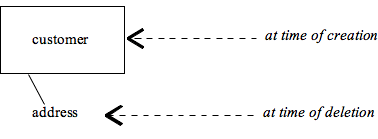
Figure 2.  Multiple Events for a Simple Rule.

RuleA customer must have an address.

This rule produces…

Update event #1:  When an instance of customer is created.

Update event #2:  When an attempt occurs to delete (nullify) the value of address.

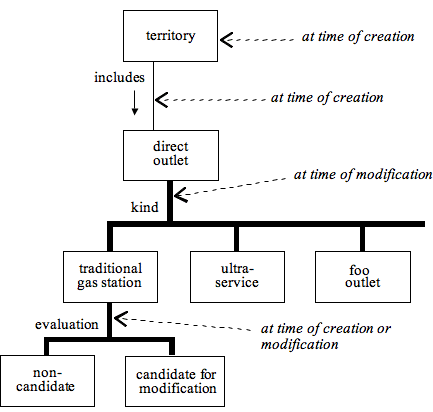
Figure 3.  Multiple Events for a More Complex Rule.

RuleA territory must not include more than one of the following:
    * Non-candidate traditional gas station.
    * Ultra-service.
    * Food outlet.

This rule produces…

Update event #1:  When an instance of territory is created.

Update event #2:  When an instance of direct outlet is added to (included in) an existing territory.

Update event #3:  When an instance of direct outlet already included in a territory changes kind.

Update event #4:  When an instance of traditional gas station already included in a territory gets or changes evaluation.

References

[1]  Excerpted from Chapter 2, Business Rule Concepts:  Getting to the Point of Knowledge (Second Edition), by Ronald G.  Ross, September 2005.  ISBN 0-941049-06-X - www.BRSolutions.com return to article

[2] www.BusinessRulesGroup.orgreturn to article

[3]  More precisely, an event from this perspective can be defined as any change in state. return to article

[4]  The specific update event that poses a potential violation of the rule is actually the deletion of an instance for the 'is assigned to' fact type. return to article

[5]  Rules do exist that are specific to individual update events, but these rules represent the exception, rather than the general case. return to article

[6]  I mean "produces" in the sense of can be analyzed to discover.return to article

[7]  An obvious exception is if the rule is qualified in such manner that it applies only when a given event occurs, for example:  A customer must be assigned to an agent who lives in the same city at the time of assignment.return to article


standard citation for this article:
Ronald G. Ross, "Rules vs. Processes (Again) — Part 2:  Now for Events," Business Rules Journal, Vol. 9, No. 7 (July 2008), URL:  http://www.BRCommunity.com/a2008/b427.html  

 about . . .

 RONALD G. ROSS


Ronald G. Ross is recognized internationally as the "father of business rules." He has Chaired the annual Business Rules Forum since 1997. He was a charter member of the Business Rules Group in the 1980s, and an editor of two landmark BRG papers, The Business Motivation Model and the Business Rules Manifesto. He is active in standards development, with core involvement in SBVR.

Mr. Ross is Executive Editor of BRCommunity.com and its flagship publication, Business Rules Journal. He is author of eight professional books, including Business Rule Concepts (2009), a just released 3rd edition of his popular, easy-to-read 1998 handbook. Mr. Ross speaks frequently at industry events worldwide.

Mr. Ross is Co-Founder and Principal of Business Rule Solutions, LLC and is actively engaged in consulting, training and research. He co-developed RuleSpeak®. Mr. Ross gives highly regarded public seminars in North America through AttainingEdge and in Europe through IRM-UK.

For additional information about Mr. Ross, please visit his personal website at www.RonRoss.info.

July 2010
Business Rules vs. System Design Choices

June 2010
Four Useful Constructs for Developing a Structured Business Vocabulary: Special-Purpose Elements of Structure for Fact Models

May 2010
Eight Things You Need to Know About Fact Types Bringing Verbs into Structured Business Vocabulary

April 2010
Business Vocabulary: The Most Basic Requirement of All

March 2010
What Is a Business Rule?

February 2010
CRUD in Business Rules: Accident-Prone Decision Logic

January 2010
The Point of Knowledge

December 2009
When is an Exception Really an Exception? The Business Rule Principles of Accommodation and Wholeness

November 2009
Verb-ish Models for Verbalization: Give Us Back Our Verbs!

October 2009
From Rulebook Management to Business Governance: Where Business Rules Fit

September 2009
What You Need to Know About Rulebook Management

August 2009
When Is a Door Not a Door? ~ Basic Ideas of the Business Rules Paradigm

July 2009
General Rulebook Systems (GRBS): What's the General Idea?

June 2009
Becoming Strategy-Driven: The Policy Charter

May 2009
Product Quality and a Longer-Term View: A 'Simple' Matter of Business Policies

April 2009
RuleSpeak® Sentence Forms: Specifying Natural-Language Business Rules in English

March 2009
The Rulebook: To Play Ball You Need Rules

February 2009
Extreme Business Agility (Part 6): A Manifesto-in-Progress on the Semantic Re-Engineering of Products

January 2009
Extreme Business Agility (Part 5): The Optimal Edge of Business Performance

December 2008
Extreme Business Agility (Part 4): Change Deployment Hell

November 2008
Extreme Business Agility ~ Part 3: Examples of Non-Agile vs. Agile Business Capabilities

October 2008
Extreme Business Agility ~ Part 2: A Semantic Approach to Re-Engineering Your Company's Products

September 2008
Extreme Business Agility — Part 1: A Value Chain for Re-Engineering Your Company’s Products

August 2008
My Son, Business Rule Analyst — Governance and Compliance Through Young Eyes

July 2008
Rules vs. Processes (Again) — Part 2: Now for Events

June 2008
Rules vs. Processes (Again) — Part 1: There’s Simply No Need for Confusion

May 2008
Legacy Modernization, Semantics, and the Knowledge Economy ~ Have You Connected the Dots Yet?!

April 2008
The Emergence of SBVR and the True Meaning of ‘Semantics’: Why You Should Care (a Lot!) ~ Part 2

March 2008
The Emergence of SBVR and the True Meaning of ‘Semantics’: Why You Should Care (a Lot!) ~ Part 1

February 2008
The Phoenix Strategy ~ A Lower-Risk Approach to Rejuvenating Systems and Legacy Modernization

January 2008
'Rules of Record' Why 'System of Record' Isn't Enough

December 2007
The Decision Center: A Center of Excellence for Coordinating Business Rules and Other Process 'Smarts'

November 2007
The Latency of Decisions ~ New Ideas on the ROI of Business Rules

October 2007
Legacy Systems -- Poorly Engineered or Over-Engineered? New Insights about Business Rules and Enterprise Decisioning

September 2007
The Value of Decisions ~ New Ideas on the ROI of Business Rules

August 2007
A Case of Dueling Manifestos? Business Rules and Enterprise Decision Management

July 2007
What's Wrong with If-Then Syntax For Expressing Business Rules ~ One Size Doesn't Fit All

June 2007
Are IT Terms Fundamental to Every Business? Not!

May 2007
Are all Rules Business Rules? Not!

April 2007
Are Software Requirements Rules? Not!

March 2007
Are Integrity Constraints Business Rules? Not!

February 2007
From Rule Management to Business Governance, Part 4: Governance Engineers and the Chief Governance Officer (CGO)

January 2007
From Rule Management to Business Governance, Part 3: Re-Engineering the Governance Process

December 2006
From Rule Management to Business Governance, Part 2: Governance and How it Relates to Business Rules

November 2006
From Rule Management to Business Governance, Part 1: Governance and How it Relates to Business Rules

October 2006
Rules and Processes: Examples Showing How They Relate

September 2006
The Meaning of Things: Definitions, Intensions, Rules, and Extensions

August 2006
Re-Vitalize, Don't Just Re-platform! ~ Three Tests for Whether Your Company 'Gets It' with Respect to Re-Platforming Business IP

July 2006
The Dirty Secrets About Your Company's Business IP That Nobody Wants to Talk About

June 2006
A Personal Insurance Saga ~ The Economics of Business Rules

May 2006
Concepts, Definitions, and Rules: RuleSpeak® Practices

April 2006
The RuleSpeak® Business Rule Notation

March 2006
How Rules and Processes Relate ~ Part 6. Point-of-Knowledge Architecture (POKA)

February 2006
How Rules and Processes Relate ~ Part 5. Scripts -- Rule-Friendly Process Models

January 2006
How Rules and Processes Relate ~ Part 4. Business Processes vs. System Processes

December 2005
How Rules and Processes Relate ~ Part 3. Three Best Practices for Designing Business Processes with Rules

November 2005
How Rules and Processes Relate ~ Part 2. Business Processes

October 2005
How Rules and Processes Relate ~ Part 1. The Challenges

September 2005
Rule Quality ~ The Route to Trustworthy Business Logic

August 2005
Decision Tables, Part 2 ~ The Route to Completeness

July 2005
Decision Tables, Part 1 ~ The Route to Consolidated Business Logic

June 2005
Rule Reduction ~ The Route to Atomic Business Rules

May 2005
Essence Definitions and Business Rules ~ Developing Stable Anchor Points for Operational Knowledge

April 2005
Can You Violate Structural Rules? (part 3) ~ The Difference Between Breaking Rules and 'Breaking' Knowledge

March 2005
Can You Violate Structural Rules? (Part 2) ~ The Difference Between How to Compute and How to Behave

February 2005
Can You Violate Structural Rules? (Part 1) ~ The Difference Between Violations and Bad Decisions


Janauary 2005
Business Rules and Knowledge Workers ~ Getting to the 'Point of Knowledge'


December 2004
Can a Definition be Violated? ~ Definitions and Business Rules


November 2004
Rustling Up Good Definitions ~ There's a Lot Less and a Lot More to It


October 2004 

Clarifying Clarifications ~ Universal 'And' to the Rescue


September 2004 

Relearning the Basics of Communicating ~ Business Semantics and Business Rules


August 2004 

The Light World vs. the Dark World ~ Business Rules for Authorization


July 2004 

Best-Fit Decision Points ~ How They Fit into the Business Rule Approach


June 2004 

What Rule Independence Means to System Models ~ Less and More than You Think!


May 2004 

The Semantics Lexicon ~ Terms For The Business Rules / Smart Process


April 2004 

Don't Reinvent Rule Engines!


March 2004 

Rules And Compliance Tactics


February 2004 

Tracing the Path of Rule Reduction


December 2003

Do Rules Decompose To Processes Or Vice Versa?


November 2003

Should You Encapsulate Knowledge in Modeling Real-World Things?


October 2003

Business Rules, Encapsulation, and Models of the Real World


September 2003

Business vs. Environment in Business Models


August 2003

Requirement Statement vs. Rule Statement


July 2003

Rules as Constraints:  On or By the System Design?


June 2003

Rules Reveal Events -- Not Actions


May 2003

Actions Are Not Rules (and Vice Versa)


April 2003

The Definitions of 'Business Rule' and 'Rule'


March 2003

Business Problems Addressed by the Business Rule Approach


January 2003

About the Business Rules Manifesto ~ The Business Rule Message in a Nutshell


November 2002

Business Rules for the Company's Provisioning Processes ~ There’s a Lot More to Reference Data than Just Data!


September 2002

The Terminator -- I'll be Back (with Just the Right Term)


July 2002

What Does it Mean to be Business-Driven? (Part 2)


May 2002

What Does it Mean to be Business-Driven? (Part 1)


March 2002

A Telltale E-mail Trail:  The Case for In-Line Business Rule Analysis


January 2002

Managing M x N Vs. M + N, Market-Driven Economies, and Other eCommerce Issues (part 2)


November 2001

Managing M x N Vs. M + N, Market-Driven Economies, and Other eCommerce Issues (part 1)


September 2001

The BRS Rule Classification Scheme


July 2001

Minding Your P's and Q's


May 2001

RuleSpeak"! -- Templates And Guidelines For Business Rules


March 2001

Business Rules In Business Processes ~ Title Rules For Process And Rules For Product/Service


January 2001

What Is Rule Management About?


November 2000

Let's Make a Deal: A Killer App for Business Rules


September 2000

The Re's Of Business Rules


July 2000

What Are Fact Models And Why Do You Need Them? (Part 2)


May 2000

What Are Fact Models And Why Do You Need Them? (Part 1)


March 2000

What is a 'Business Rule'?


January 2000

Current Thoughts On Expressing Business Rules


November 1999

The Fin de Siegle Legacy Mindset
 

September 1999

Analysis Paralysis Just May Save Your Life
 

July 1999

If We Had Started Coding Already...
 

May 1999

Your Core Business Processes Need a Rule Engine
 

March 1999

Who or What is a True Business Analyst?
 

January 1999

Four Things Wrong with the Way We Develop Information Systems


[ Home ] [ Staff ] [ About BRC Publications ] [ Editorial Feedback ] [ About BRCommunity ]
[ Contributor's Guidelines ] [ Privacy Policy ] [ Technical Support ]