Search ::     [ Advanced ]
Username:   Password: Auto login next time?  

Business Rule Solutions : World Class Training For Critical Business Innovations

JBossďż˝ Enterprise BRMS from Red Hat

RuleXpress: The business tool for expressing and communication business rules.

IDIOM Software


     ROSS ARCHIVES ...
untitled

Decision Analysis (Part 3)
Defining Scope

by Ronald G. Ross

This column is excerpted from Decision Analysis Using Decision Tables and Business Rules by Ronald G.  Ross (Oct. 2010), an in-depth white paper available free on:  http://www.brsolutions.com/b_decision.php

Managing any project effectively requires clearly defined scope.  Projects involving decision analysis are no different in that regard.

In decision analysis, scope is always ultimately based on cases.  A case that is not in scope must be handed off (to some expert, manager, process, or other decision logic).  The decision logic produced from decision analysis must be able to give a definite outcome[1] for every case provably in scope.

Scope for decision analysis is based on three essential elements:

  1. The question the decision logic answers.
  2. Limitations about the kinds of cases covered.
  3. Exceptions.

The first two elements are highly intertwined.  For example, the question for some decision logic might be expressed in either of the following two ways:

(a)  Is an applicant eligible for auto insurance?

(b)  Is an applicant eligible for insurance?

Cases in Scope:  auto insurance

The resulting scope is the same for either form of specification.

Refinements to scope mean adding additional limitations that narrow the range of cases the decision logic handles (i.e., should give definite outcomes for).  For example, the scope of the decision logic above might be further refined in either of the following ways:

(a)  Is an applicant eligible for auto insurance for USA under $1 million?

(b)  Is an applicant eligible for insurance?

Cases in Scope:
  •  auto insurance
  •  USA
  •  under $1 million

Two more limitations, USA and under $1 million, have been added to both expressions above.  An implicit AND is understood to exist among all three scope items in each expression.  (If there is any doubt about the intended ANDing it should be given explicitly.) As before, both forms of specification result in exactly the same scope.

As scope is increasingly refined, listing limitations on scope separately — as in (b) — usually proves more effective, especially if the vocabulary used in the expressions is coordinated with a fact model (structured business vocabulary) — strongly recommended.  For example:

Question:  Is an applicant eligible?

Cases in Scope:  Any application submitted by an applicant that:
  •  is for the product 'auto insurance'
  •  is for a policy covering the 'USA'
  •  requests a coverage amount less than $1 million

Considerations and Exceptions

The outcome for a case in scope is usually determined by a standard or typical set of considerations.  If not, then the case is an exceptional case, or simply an exception.

A consideration is a factor for making an operational business decision.  For auto insurance, considerations might include driving history, evidence of insurance, insurance risk score, credit rating, and state/province.  As these examples illustrate, considerations should always involve business factors.

The relation of considerations to cases is generally class to instance.

  • A consideration is a kind of circumstance that some decision logic addresses.
  • A case is some particular circumstance(s) the decision logic addresses.

For example, suppose state/province is a consideration for a decision.  Then the particular instances Texas and British Columbia are cases of that consideration for that decision.  As this example illustrates, a case considered by an operational business decision can be as simple as a single instance for just one of the decision's considerations.  Such a case is very general.

More often, cases addressed by an operational business decision represent combined instances of many or all of the decision's considerations.  Such a case is very specific.  For example, the following instances might combine to represent one specific case addressed by a decision:

Consideration           Instance
driving history         good
evidence of insurance   acceptable
insurance risk score    154         one specific case
credit rating           poor
state                   Texas

An exceptional case (or simply exception) is a case that is based on none of the standard or typical considerations.  Suppose as before that for auto insurance the standard considerations are:  driving history, evidence of insurance, insurance risk score, credit rating, and state/province.  Then suppose there are business rules denying auto insurance for any:
      •  felon
      •  person under age 16

Since criminal status and age respectively are not among the standard or typical considerations for the decision logic, these cases are deemed exceptions.

It is important to note that exceptions are in scope.  Definite outcomes are always given for exceptions, even if simply to deny (or accept) some result out-of-hand.

Typically at most 20% of all possible cases are exceptional.  If the percentage of exceptional cases exceeds 20% for some decision logic, the standard or typical considerations should be re-examined.

Cases that are not exceptional are considered standard.  A standard case is a case in scope that is:

  • Regular or common.
  • Based on some or all the usual considerations.
  • Subject to normal treatment and cannot be denied (or accepted) out of hand.

To complete specification of scope for some decision logic, the business rules for handling exceptions must be given.  For example:[2]

  • An applicant that has been convicted of a felony involving a motor vehicle is always considered ineligible for auto insurance.

  • An applicant younger than 16 years of age is always considered ineligible for auto insurance.

Simplifying the Expression of Decision Logic for Standard Cases

Techniques for simplifying the expression of decision logic focus on where and how various components are specified.  Expression of decision logic for standard cases can be simplified in two important ways:

  1. By listing limitations for scope separately.  As discussed earlier, this can be accomplished either by including the limitations in the question representing the decision logic or by listing them apart from (but associated with) the question.

  2. By writing business rules for the exceptional cases.  These business rules handle the special circumstances in which the exceptions apply.

Specifying these two components separately allows them to be assumed by the decision logic for standard cases.  They do not need to be addressed again in expressing the decision logic for standard cases.

In other words, specifications for the decision rules covering all non-exceptional cases within scope need consider only standard or typical considerations.  Circumstances pertaining to scope and exceptions do not have to be addressed explicitly in the decision logic for standard cases.  This simplification results no matter what form that decision logic takes (e.g., decision tables, business rule statements, or other).

This simplification results in slim decision logic for standard cases.  Since that decision logic can be quite complex itself, such a priori simplification proves very helpful.  Two additional points are worth noting:

  • How the overall configuration of decision logic is implemented 'under the covers' should not be a concern.  All components of the decision logic needed for correct evaluation of cases from a business point of view have been addressed.

  • Wherever the decision logic is re-used, all the logic must be applied (deployed), including the separate specifications for scope items and exceptions.  The decision logic for standard cases depends on the whole; re-use of just some subset can easily produce inappropriate or incorrect results.

Simplifying the Analysis of Decision Logic for Standard Cases

A key to simplifying the analysis of decision logic for standard cases is to divide and conquer.  Projects should be carved out that can be undertaken separately and, if resources permit, in parallel.  For example:  Suppose the considerations used to determine eligibility for auto insurance in the USA for well-heeled applicants are different from those for ordinary applicants in terms of income, employment, and experience.  If the two sets of considerations are non-overlapping, the decision logic for the two kinds of cases can be developed separately.

Often, the divide-and-conquer strategy leads to independent subdecisions.  An independent subdecision is one of a collection of two or more decisions on which another decision is dependent, where each subdecision has its own set of distinct (non-overlapping) considerations.

A good example of independent subdecisions is the launching of a space shuttle or manned rocket.  Before the ultimate decision Should the craft be launched?  is addressed, an entire checklist of subdecisions is addressed, each with its own set of considerations.  These subdecisions pertain to weather, fuel systems, communications, down-field recovery, etc.

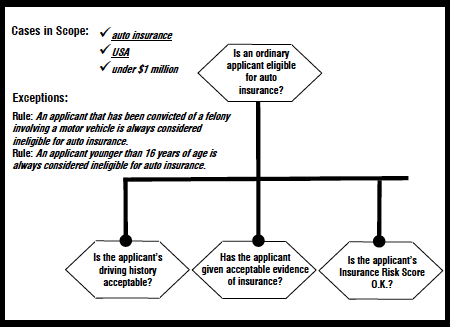
The decision logic for the decision Is an applicant eligible for auto insurance for USA under $1 million?  might be analyzed as independent subdecisions.  If so, each of the following subdecisions would have its own unique set of considerations.

  • Is the applicant's driving history acceptable?

  • Has the applicant given acceptable evidence of insurance?

  • Is the applicant's Insurance Risk Score O.K.?

  • etc.

Figure 1.  Q-Chart for the decision Is an applicant eligible for auto insurance for USA under $1 million?

The decision logic for the overall decision can be portrayed as a Question Chart (Q-Chart for short) as in Figure 1.  This Q-Chart provides a visualization of a decision structure; that is, how some decisions are formally organized.  Q-Charting is an important and powerful new tool for business analysts.[3]

References

[1] Definite outcome means a real business answer to the question being asked.  An outcome such as unable to determine is not a real business answer.  Any such case is not in scope and must be handed off. return to article

[2]  RuleSpeak is a set of guidelines for expressing business rules in structured natural language.  RuleSpeak guidelines are available for free in English, Spanish, Dutch and German on www.RuleSpeak.com.  All statements of business rules in this discussion use RuleSpeak. return to article

[3]  For more about Q-Charting, refer to:  Ronald G.  Ross, "Introducing Question Charts (Q-Charts™) for Analyzing Operational Business Decisions:  A New Technique for Getting at Business Rules," Business Rules Journal, Vol.  11, No.  12 (Dec.  2010), URL:  http://www.BRCommunity.com/a2010/b567.htmlreturn to article


standard citation for this article:
Ronald G. Ross, "Decision Analysis (Part 3):  Defining Scope," Business Rules Journal, Vol. 12, No. 9 (Aug. 2011), URL:  http://www.BRCommunity.com/a2011/b609.html  

 about . . .

 RONALD G. ROSS

Ronald G. Ross is Principal and Co-Founder of Business Rule Solutions, LLC, where he actively develops and applies the IPSpeak methodology including RuleSpeak®, DecisionSpeak and TableSpeak.

Ron is recognized internationally as the "father of business rules." He is the author of ten professional books including the groundbreaking first book on business rules The Business Rule Book in 1994. His newest are:

Ron serves as Executive Editor of BRCommunity.com and its flagship publication, Business Rules Journal. He is a sought-after speaker at conferences world-wide. More than 50,000 people have heard him speak; many more have attended his seminars and read his books.

Ron has served as Chair of the annual International Business Rules & Decisions Forum conference since 1997., now part of the Building Business Capability (BBC) conference. He was a charter member of the Business Rules Group (BRG) in the 1980s, and an editor of its Business Motivation Model (BMM) standard and the Business Rules Manifesto. He is active in OMG standards development, with core involvement in SBVR.

Ron holds a BA from Rice University and an MS in information science from Illinois Institute of Technology. For more information about Mr. Ross, visit www.RonRoss.info, which hosts his blog. Tweets: @Ronald_G_Ross

May 2013
Re-Cycling Shut-Down
Let's Face It — Some Rules Are Just Silly!

By Ronald G. Ross


April 2013
Tabulation of Lists in RuleSpeak® — Using "The Following" Clause
By Ronald G. Ross


March 2013
Requirements are Rules: True or False?
By Ronald G. Ross


February 2013
Breaking the Rules: Breach Questions
By Ronald G. Ross


January 2013
Business Rules, Business Processes, and Business Agility: Basic Principles — Celebrating the 10th Anniversary of the Business Rules Manifesto (Part 3)
By Ronald G. Ross


December 2012
Business Rules, Business Processes, and Business Agility: Basic Principles — Celebrating the 10th Anniversary of the Business Rules Manifesto (Part 2)
By Ronald G. Ross


November 2012
Strategy for Business Solutions: Part 3: Adjusting and Fine-Tuning a Strategy
By Ronald G. Ross with Gladys S.W. Lam


October 2012
Strategy for Business Solutions: Part 2 — Business Mission and Business Goals
By Ronald G. Ross with Gladys S.W. Lam


October 2012
Big-P Process is Dead; Long Live Configuration Agility!
By Ronald G. Ross


September 2012
Strategy for Business Solutions: Part 1 — The Policy Charter
By Ronald G. Ross with Gladys S.W. Lam


August 2012
Business Rules, Requirements, and Business Analysis: Basic Principles — Celebrating the 10th Anniversary of the Business Rules Manifesto
By Ronald G. Ross


July 2012
Strategy-Based Metrics for Measuring Business Performance
By Ronald G. Ross with Gladys S.W. Lam


June 2012
How Business Processes, Strategy, and Business Policies Relate
By: Ronald G. Ross


May 2012
Business Processes: Better with Business Rules
By: Ronald G. Ross


April 2012
Business Policies, Business Rules, and Rulebook Management: Let Us Be Well-Governed
By: Ronald G. Ross


March 2012
What's Really Needed to Align Business and IT Part 2: Strategy for a Business Solution
By: Ronald G. Ross


February 2012
What's Really Needed to Align Business and IT Part 1: Creating True Business Solutions
By: Ronald G. Ross


January 2012
Concept Model vs. Fact Model vs. Conceptual Data Model; Just a Matter of Semantics?
By: Ronald G. Ross


December 2011
Business Rules: Basic Principles
By: Ronald G. Ross with Gladys S.W. Lam


November 2011
Know-How Models: How Business Rules, Decisions, and Events Relate in True-to-Life Business Models

October 2011
Business Analysis with Business Rules
By: Ronald G. Ross with Gladys S.W. Lam


September 2011
How Business Processes and Business Rules Relate

August 2011
Decision Analysis (Part 3): Defining Scope

July 2011
Decision Analysis (Part 2): The Basic Elements of Operational Business Decisions

June 2011
Decision Analysis (Part 1): What Kind of Decisions?

May 2011
How Long Will Your Fact Model Last? — The Power of Structured Business Vocabularies

April 2011
More on the If-Then Format for Expressing Business Rules: Questions and Answers

March 2011
Operational Business Decisions
Whose Decisions Are They Anyway?


February 2011
The Anatomy of Decisions
The Business-Rule View


January 2011
Why Rulebook Management? Because Software Requirements and Business Rules Simply Aren't the Same!

December 2010
Introducing Question Charts (Q-Charts™) for Analyzing Operational Business Decisions: A New Technique for Getting at Business Rules

November 2010
Agility Based on Business Rules It's Just Common Sense

October 2010
Five Tests for What Is a Business Rule?

September 2010
Can a Business Rule Be Enforced Differently in Different Contexts?

August 2010
How Far Can You Take Decisioning?

July 2010
Business Rules vs. System Design Choices

June 2010
Four Useful Constructs for Developing a Structured Business Vocabulary: Special-Purpose Elements of Structure for Fact Models

May 2010
Eight Things You Need to Know About Fact Types Bringing Verbs into Structured Business Vocabulary

April 2010
Business Vocabulary: The Most Basic Requirement of All

March 2010
What Is a Business Rule?

February 2010
CRUD in Business Rules: Accident-Prone Decision Logic

January 2010
The Point of Knowledge

December 2009
When is an Exception Really an Exception? The Business Rule Principles of Accommodation and Wholeness

November 2009
Verb-ish Models for Verbalization: Give Us Back Our Verbs!

October 2009
From Rulebook Management to Business Governance: Where Business Rules Fit

September 2009
What You Need to Know About Rulebook Management

August 2009
When Is a Door Not a Door? ~ Basic Ideas of the Business Rules Paradigm

July 2009
General Rulebook Systems (GRBS): What's the General Idea?

June 2009
Becoming Strategy-Driven: The Policy Charter

May 2009
Product Quality and a Longer-Term View: A 'Simple' Matter of Business Policies

April 2009
RuleSpeak® Sentence Forms: Specifying Natural-Language Business Rules in English

March 2009
The Rulebook: To Play Ball You Need Rules

February 2009
Extreme Business Agility (Part 6): A Manifesto-in-Progress on the Semantic Re-Engineering of Products

January 2009
Extreme Business Agility (Part 5): The Optimal Edge of Business Performance

December 2008
Extreme Business Agility (Part 4): Change Deployment Hell

November 2008
Extreme Business Agility ~ Part 3: Examples of Non-Agile vs. Agile Business Capabilities

October 2008
Extreme Business Agility ~ Part 2: A Semantic Approach to Re-Engineering Your Company's Products

September 2008
Extreme Business Agility — Part 1: A Value Chain for Re-Engineering Your Company’s Products

August 2008
My Son, Business Rule Analyst — Governance and Compliance Through Young Eyes

July 2008
Rules vs. Processes (Again) — Part 2: Now for Events

June 2008
Rules vs. Processes (Again) — Part 1: There’s Simply No Need for Confusion

May 2008
Legacy Modernization, Semantics, and the Knowledge Economy ~ Have You Connected the Dots Yet?!

April 2008
The Emergence of SBVR and the True Meaning of ‘Semantics’: Why You Should Care (a Lot!) ~ Part 2

March 2008
The Emergence of SBVR and the True Meaning of ‘Semantics’: Why You Should Care (a Lot!) ~ Part 1

February 2008
The Phoenix Strategy ~ A Lower-Risk Approach to Rejuvenating Systems and Legacy Modernization

January 2008
'Rules of Record' Why 'System of Record' Isn't Enough

December 2007
The Decision Center: A Center of Excellence for Coordinating Business Rules and Other Process 'Smarts'

November 2007
The Latency of Decisions ~ New Ideas on the ROI of Business Rules

October 2007
Legacy Systems -- Poorly Engineered or Over-Engineered? New Insights about Business Rules and Enterprise Decisioning

September 2007
The Value of Decisions ~ New Ideas on the ROI of Business Rules

August 2007
A Case of Dueling Manifestos? Business Rules and Enterprise Decision Management

July 2007
What's Wrong with If-Then Syntax For Expressing Business Rules ~ One Size Doesn't Fit All

June 2007
Are IT Terms Fundamental to Every Business? Not!

May 2007
Are all Rules Business Rules? Not!

April 2007
Are Software Requirements Rules? Not!

March 2007
Are Integrity Constraints Business Rules? Not!

February 2007
From Rule Management to Business Governance, Part 4: Governance Engineers and the Chief Governance Officer (CGO)

January 2007
From Rule Management to Business Governance, Part 3: Re-Engineering the Governance Process

December 2006
From Rule Management to Business Governance, Part 2: Governance and How it Relates to Business Rules

November 2006
From Rule Management to Business Governance, Part 1: Governance and How it Relates to Business Rules

October 2006
Rules and Processes: Examples Showing How They Relate

September 2006
The Meaning of Things: Definitions, Intensions, Rules, and Extensions

August 2006
Re-Vitalize, Don't Just Re-platform! ~ Three Tests for Whether Your Company 'Gets It' with Respect to Re-Platforming Business IP

July 2006
The Dirty Secrets About Your Company's Business IP That Nobody Wants to Talk About

June 2006
A Personal Insurance Saga ~ The Economics of Business Rules

May 2006
Concepts, Definitions, and Rules: RuleSpeak® Practices

April 2006
The RuleSpeak® Business Rule Notation

March 2006
How Rules and Processes Relate ~ Part 6. Point-of-Knowledge Architecture (POKA)

February 2006
How Rules and Processes Relate ~ Part 5. Scripts -- Rule-Friendly Process Models

January 2006
How Rules and Processes Relate ~ Part 4. Business Processes vs. System Processes

December 2005
How Rules and Processes Relate ~ Part 3. Three Best Practices for Designing Business Processes with Rules

November 2005
How Rules and Processes Relate ~ Part 2. Business Processes

October 2005
How Rules and Processes Relate ~ Part 1. The Challenges

September 2005
Rule Quality ~ The Route to Trustworthy Business Logic

August 2005
Decision Tables, Part 2 ~ The Route to Completeness

July 2005
Decision Tables, Part 1 ~ The Route to Consolidated Business Logic

June 2005
Rule Reduction ~ The Route to Atomic Business Rules

May 2005
Essence Definitions and Business Rules ~ Developing Stable Anchor Points for Operational Knowledge

April 2005
Can You Violate Structural Rules? (part 3) ~ The Difference Between Breaking Rules and 'Breaking' Knowledge

March 2005
Can You Violate Structural Rules? (Part 2) ~ The Difference Between How to Compute and How to Behave

February 2005
Can You Violate Structural Rules? (Part 1) ~ The Difference Between Violations and Bad Decisions


Janauary 2005
Business Rules and Knowledge Workers ~ Getting to the 'Point of Knowledge'


December 2004
Can a Definition be Violated? ~ Definitions and Business Rules


November 2004
Rustling Up Good Definitions ~ There's a Lot Less and a Lot More to It


October 2004 

Clarifying Clarifications ~ Universal 'And' to the Rescue


September 2004 

Relearning the Basics of Communicating ~ Business Semantics and Business Rules


August 2004 

The Light World vs. the Dark World ~ Business Rules for Authorization


July 2004 

Best-Fit Decision Points ~ How They Fit into the Business Rule Approach


June 2004 

What Rule Independence Means to System Models ~ Less and More than You Think!


May 2004 

The Semantics Lexicon ~ Terms For The Business Rules / Smart Process


April 2004 

Don't Reinvent Rule Engines!


March 2004 

Rules And Compliance Tactics


February 2004 

Tracing the Path of Rule Reduction


December 2003

Do Rules Decompose To Processes Or Vice Versa?


November 2003

Should You Encapsulate Knowledge in Modeling Real-World Things?


October 2003

Business Rules, Encapsulation, and Models of the Real World


September 2003

Business vs. Environment in Business Models


August 2003

Requirement Statement vs. Rule Statement


July 2003

Rules as Constraints:  On or By the System Design?


June 2003

Rules Reveal Events -- Not Actions


May 2003

Actions Are Not Rules (and Vice Versa)


April 2003

The Definitions of 'Business Rule' and 'Rule'


March 2003

Business Problems Addressed by the Business Rule Approach


January 2003

About the Business Rules Manifesto ~ The Business Rule Message in a Nutshell


November 2002

Business Rules for the Company's Provisioning Processes ~ There’s a Lot More to Reference Data than Just Data!


September 2002

The Terminator -- I'll be Back (with Just the Right Term)


July 2002

What Does it Mean to be Business-Driven? (Part 2)


May 2002

What Does it Mean to be Business-Driven? (Part 1)


March 2002

A Telltale E-mail Trail:  The Case for In-Line Business Rule Analysis


January 2002

Managing M x N Vs. M + N, Market-Driven Economies, and Other eCommerce Issues (part 2)


November 2001

Managing M x N Vs. M + N, Market-Driven Economies, and Other eCommerce Issues (part 1)


September 2001

The BRS Rule Classification Scheme


July 2001

Minding Your P's and Q's


May 2001

RuleSpeak"! -- Templates And Guidelines For Business Rules


March 2001

Business Rules In Business Processes ~ Title Rules For Process And Rules For Product/Service


January 2001

What Is Rule Management About?


November 2000

Let's Make a Deal: A Killer App for Business Rules


September 2000

The Re's Of Business Rules


July 2000

What Are Fact Models And Why Do You Need Them? (Part 2)


May 2000

What Are Fact Models And Why Do You Need Them? (Part 1)


March 2000

What is a 'Business Rule'?


January 2000

Current Thoughts On Expressing Business Rules


November 1999

The Fin de Siegle Legacy Mindset
 

September 1999

Analysis Paralysis Just May Save Your Life
 

July 1999

If We Had Started Coding Already...
 

May 1999

Your Core Business Processes Need a Rule Engine
 

March 1999

Who or What is a True Business Analyst?
 

January 1999

Four Things Wrong with the Way We Develop Information Systems


November/December 1998
Push-Type Data Hub vs. Pull-Type Data Warehouse
By Ronald G. Ross

September/October 1998
What Knowledge Management is About (And What it Has To Do With Business Rules)
By Ronald G. Ross

May/June 1998
The Next Great Leap Forward ~ About the Changes You See
By Ronald G. Ross

March/April 1998
Business Rules as Customer Interface
By Ronald G. Ross

January/February 1998
Components and Business Rules: Do They Connect?
By Ronald G. Ross

November/December 1997
The Policy Charter: A Small-Sized Picture of the Big Picture
By Ronald G. Ross

September/October 1997

Implementing Application Packages: Is There A Better Way?

By Ronald G. Ross


July/August 1997

'Why' is Why Business Rule Methodology is Different

By Ronald G. Ross


May/June 1997

Never-ending On-the-Job Training

By Ronald G. Ross


September/October 1996

Re-Usability in the Business Rule Approach

By Ronald G. Ross


March/April 1996

The Newest Idea In Business Rules: Rules Normalize!

By Ronald G. Ross


January/February 1996

An Open Letter to DBMS Vendors: We Need Active Database Systems

By Ronald G. Ross


May/June 1995

The Greatest Irony Of The Information Age: Business Rules

By Ronald G. Ross


November/December 1995

Business Rules: Knowledge For Knowledge Workers

By Ronald G. Ross


March/April 1994

"Play Ball!"

By Ronald G. Ross


November/December 1988

The History Of Steam-Powered Ships

By Ronald G. Ross


January/February 1994

"Business Rules, At What Cost?"

By Ronald G. Ross


May/June 1994

Business Rules:  Birth of a Movement

By Ronald G. Ross


July/August 1991

Why I Like the Zachman Framework Architecture"

By Ronald G. Ross


March/April 1997

Business Process Re-Engineering

By Ronald G. Ross


[ Home ] [ Staff ] [ About BRC Publications ] [ Editorial Feedback ] [ About BRCommunity ]
[ Contributor's Guidelines ] [ Privacy Policy ] [ Technical Support ]