
SBVR Speaks: (5) Notations for Business Rule Expression

In January 2008, the "Semantics of Business Vocabulary and Business Rules" (SBVR) was first presented by the Object Management Group (OMG) as an official specification of the OMG. Version 4 (SBVR 1.4) was published in 2017.[1]
'Notation' is used in SBVR (as instructed by the OMG) to mean any language used to represent semantics or, more precisely, abstract syntax. Notations can be verbal, graphical, or any combination thereof. Other words for 'notation' are 'grammar', 'syntax', and 'concrete surface syntax'.[3]
It is important to keep in mind that SBVR Structured English (introduced here and covered in detail in SBVR Annex A) is just one of possibly many notations that can be used to express the SBVR Metamodel. As a notation, it is non-normative in the SBVR standard.[4]
SBVR Structured English for Rule Expression
The most common means of expressing definitions and business rules is through statements, not diagrams. While diagrams (e.g., concept model diagrams) are helpful for seeing how concepts are related, they are impractical as a primary means of defining vocabulary and expressing business rules.
Accordingly, the SBVR specification itself defines an English vocabulary for describing vocabularies and stating rules. There are many different ways that this vocabulary (and other English vocabularies described using SBVR) can be combined with common English words and structures to express definitions and statements.
For rule expression, two styles are documented in the standard:
- Prefixed Rule Keyword Style
- Embedded (mixfix) Rule Keyword Style
Prefixed Rule Keyword Style
The prefixed style introduces rules by prefixing a statement with keywords that convey a modality.[5] Examples of some of the prefixed-style keywords are shown in Table 1.
Table 1. Rule keywords for use in the Prefixed Style of rule statement Behavioral ('Operative')
Definitional ('Structural')
It is obligatory that It is necessary that It is prohibited that It is impossible that It is permitted that It is possible that
This style, which is illustrated in the next section, is included in the standard for two primary reasons:
- Its rule keywords correspond to the modal operators in the logical formulation
portion of SBVR, so it illustrates the translation of notation to metamodel in the
most direct and easy-to-understand fashion.
- It is supported by the commercial reference implementation of Unisys Corporation, which is an implementation that satisfied the OMG submission's compliance requirements for finalization.
Embedded (mixfix) Rule Keyword Style
The embedded style features the use of rule keywords embedded (usually in front of a verb) within rules statements of appropriate kinds. Examples of some of the embedded-style keywords are shown in Table 2.
Table 2. Rule keywords for use in the Embedded Style of rule statement Behavioral ('Operative')
Definitional ('Structural')
... must ... ... always ... ... must not ... ... never ... ... may ... ... sometimes ...
This style of notation, which is examined more closely in a companion column,[6] is included in the standard for two primary reasons:
- It is an existing, documented notation (RuleSpeak®) that has been used with business people in actual practice for a number of years.[7]
- It clearly demonstrates that alternative notations for business rules, which some business people find more natural and/or friendly, are easily accommodated under SBVR Structured English.
Examples
Applying these two rule keyword styles, here are alternative statements that express a single rule:
- It is obligatory that each rental has at most three additional drivers.
- A rental must have at most three additional drivers.
However expressed, the semantics of rules and definitions can be formally represented in terms of the SBVR vocabulary and, particularly, in terms of logical formulations (the SBVR conceptualization of formal logic). SBVR Structured English is one such way of using English that maps mechanically to SBVR concepts. SBVR Structured English is not meant to offer all of the variety of common English, but rather, it uses a small number of English structures and common words to provide a simple and straightforward mapping.
Here are the same two rule statements, now represented formally,[8] using the font styles of SBVR Structured English:
- It is obligatory that each rental has at most three additional drivers.
- A rental must have at most three additional drivers.
Note that the rule meant by these two statements is based on the vocabulary-defined verb concept, rental has additional driver, which involves two noun concepts, termed (respectively) rental and additional driver.[9]
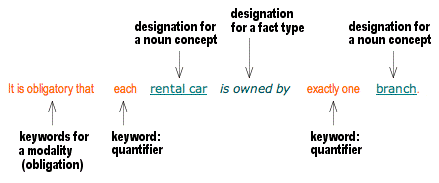
Consider the following rule statement, expressed in the prefix style and styled formally.
It is obligatory that each rental car is owned by exactly one branch.
We can see how the combination of styled elements and modality represents the formal expression of the rule. The rule statement above includes three key words or phrases, two designations for noun concepts, and one wording of a verb concept, as annotated below.
SBVR Structured English for Expression (in General)
SBVR Structured English is used to write statements and definitions that represent corresponding logical formulations. It uses a combination of font styling and defined keywords to accomplish this.
Expression Styling in SBVR Structured English
SBVR Structured English uses four font styles with these defined formal meanings:
| 1. | term | The 'term' font is used for a designation of a noun concept (other than an individual
concept) — one that is part of a vocabulary being used or defined (e.g., business rule, verb concept, semantic community). This style is applied to the designation where it
is initially defined and then again wherever the term is used. Terms are usually defined using lower-case letters unless the term includes a proper noun. Terms are defined in singular form. Plural forms are implicitly available for use. |
| 2. | Name | The 'name' font is used for the designation of an individual concept — a name of an individual.
Names tend to be proper nouns (e.g., California). This style is applied to a name where it is defined
and then again wherever the name is used. Note that names of numerical values in formal statements
are also shown in this style (e.g., 25). See the definition of 'name' in SBVR for more details. Names appear using appropriate capitalization, which is typically (but not necessarily) the first letter of each word. |
| 3. | verb | The 'verb' font is used for wordings of verb concepts — usually
a verb, preposition, or combination thereof.
The verb symbol itself is defined in the context of a verb concept wording.
The verb font is used both in the context of showing a verb concept wording
(e.g., 'statement expresses proposition') and in the context
of using it in a statement (e.g., "Each statement expresses exactly one proposition.").[10] Verb concept wordings shown as vocabulary entries are written using the singular, active verb form, with the exception that the present participle form is sometimes used for characteristics. Infinitive, subjunctive, passive, and plural forms of verbs are implicitly available for use in statements and definitions. |
| 4. | keyword | The 'keyword' font is used for linguistic symbols used to construct statements, i.e., these are
words that can be combined with other designations to form statements and definitions
(e.g., 'each' and 'it is obligatory that'). Some of the key words and phrases are listed
below. Single quotation marks are used to quote a designation or verb concept wording that
is being mentioned. If a designation is mentioned (where the designation is
itself the subject of a statement) it appears within single quote marks (e.g., 'concept' and 'California' used to talk about those designations).
Single quotes are also used around a verb concept wording that is being mentioned (e.g., when 'reference scheme is for concept' is used to talk about that wording itself). Double quotation marks are used
in other cases, such as to quote a statement. Periods also appear in the 'keyword' font. A period is used to terminate a statement (but not a definition). Other punctuation symbols (e.g., parentheses, comma) also apply the 'keyword' font when part of a formal expression. |
Key words and phrases for logical formulations
SBVR Structured English provides key words and phrases for expressing each kind of logical formulation. A sampling of these is presented here.[11] The letters 'n' and 'm' represent use of a literal whole number. The letters 'p' and 'q' represent expressions of propositions.
Quantification each universal quantification at least one existential quantification at least n at-least-n quantification at most one at-most-one quantification at most n at-most-n quantification at least n and at most m numeric range quantification
Logical Operations p and q conjunction p or q disjunction p or q but not both exclusive disjunction if p then q implication p if and only if q equivalence
Other Keywords the 1. used with a designation to make a pronominal reference to a previous use of the same designation. This is formally a binding to a variable of a quantification.
2. introduction of a name of an individual thing or of a definite descriptiona, an universal or existential quantification, depending on context based on English rules another (used with a term that has been previously used in the same statement) existential quantification plus a condition that the referent thing is not the same thing as the referent of the previous use of the term a given universal quantification pushed outside of a demonstrative expression where 'a given' is used such that it represents one thing at a time — this is used to avoid ambiguity where the 'a' by itself could otherwise be interpreted as an existential quantification.that 1. when preceding a designation for a noun concept, this is a binding to a variable (as with 'the')
2. when after a designation for a noun concept and before a wording for a verb concept, this is used to introduce a restriction on things denoted by the previous designation based on facts about them
3. when followed by a propositional statement, this used to introduce nominalization of the proposition or objectification, depending on whether the expected result is a proposition or an actuality.[12]who the same as the second use of 'that' but used for a person is of The common preposition 'of' is used as a shorthand for "that is of". For any sentential form that takes the general form of '<placeholder 1> has <placeholder 2>' there is an implicit reversed form of '<placeholder 2> is of <placeholder 1>' that has the same meaning. what used to introduce a variable in a projection as well as indicate that a projection is being formulated to be considered by a question or answer nominalization.[12]
Where a subject is repeated when using 'and' or 'or', the repeated subject can be elided. For example, the statement "An implication has an antecedent and the implication is embedded in a modal formulation." can be abbreviated to this: "An implication has an antecedent and is embedded in a modal formulation." Similarly, a repeated subject and verb can be elided. For example, the statement "An implication has an antecedent and the implication has a consequent." can be abbreviated to this: "An implication has an antecedent and a consequent."
The keyword 'not' is used within an expression before the verb "is" as a way of introducing a logical negation. Also, the key words "does not" are used before other verbs (modified to be infinitive) to introduce a logical negation.
Next time...
In this instalment we have seen the way the expression of business rules is accomplished in SBVR. Business rules, represented by business rule statements, apply the conventions of some notation (e.g., SBVR Structured English or RuleSpeak), along with specialized key words and phrases that indicate the rule's modality. Two styles — prefixed and embedded — have been discussed.
Next time, with the Business Rules Mantra in mind ("Rules are based on facts, and facts build on concepts"), we will look at the elements that business rules are based on — concepts, including verb concepts — and how they are defined and expressed as terms and other symbols.
References
[1] Semantics of Business Vocabulary and Business Rules (SBVR). Object Management Group.
The current version of SBVR is available on the OMG
site. 
[2] Quick Reference for Basic SBVR Terminology (v. 5)
[3] It is specifically not the intention of SBVR
to mandate any particular notation(s) that must or should be used with SBVR.
Indeed, this would be neither productive not desirable.
Instead, wide innovation,
experimentation, and value-adding software development in the area of compliant notations
is encouraged.
For example, additional compliant notations are encouraged.
Also welcomed and encouraged are compliant enrichments of various parts of SBVR Structured
English itself.
[4] Although the Structured English is non-normative, its
use in Clauses 8 through 21 has a normative interpretation in the SBVR model of SBVR, as described in SBVR subclause 23.4.
[5] Modality (from modal logics) is an important
aspect of SBVR but is a topic too vast for coverage here.
Modality is covered
in considerable detail throughout the standard and, in particular, in Clause 21 (where
the vocabulary for the logical formulation of semantics vocabulary is specified)
and Clause 24 (where the formal grounding model is presented and discussed).
For our introductory understanding in this series, the following two general points
should help:
1. alethic modality — the modality of necessity (also including possibility, etc.) and
2. deontic modality — the modality of obligation (also including permission, etc.).
Alethic modality aligns with SBVR's definitional (or 'structural') rule; deontic modality aligns with SBVR's behavioral (or 'operative') business rule.
[6] Ronald G. Ross, "The RuleSpeak®
Business Rule Notation," Business Rules Journal, Vol. 7, No. 4 (Apr.
2006), revised (Oct. 2013), URL: http://www.BRCommunity.com/a2006/b286b.html
[7] RuleSpeak®, by Business Rule Solutions,
LLC, as documented in Principles of the Business Rule Approach, by Ronald
G. Ross, Addison-Wesley, Boston, MA (2003), Chapters 8-12, as Annex H of SBVR, and online at RuleSpeak.com
[8] The complete semantic formulation of this rule can
be found in the introduction to the "Logical Formulation of Semantics
Vocabulary," Clause 21 of the SBVR document.
[9] The car rental examples come from EU-Rent,
a (fictitious) car rental company.
This popular case study was contributed to the SBVR effort
by Model Systems and appears in detail as Annex G of the SBVR document.
[10] Some of the terms used here to introduce the font
styles of SBVR Structured English (e.g., 'designation', 'noun concept', 'individual
concept', 'verb concept wording') will be discussed in a later article.
[11] The complete lists can be found in A.2.1 and A.2.2 of Annex A of the SBVR document.
[12] See A.2.5 of Annex A of the SBVR document.
# # #
Standard citation for this article:

About our Contributor:











Online Interactive Training Series
In response to a great many requests, Business Rule Solutions now offers at-a-distance learning options. No travel, no backlogs, no hassles. Same great instructors, but with schedules, content and pricing designed to meet the special needs of busy professionals.